 MeasureHere
How to Read a Tape Measure
Find the last whole inch before the end of what you are measuring, then count the small marks past it: on most tapes each one is 1/16 inch. Feet are marked every 12 inches, and the red marks every 16 inches show stud spacing.
Reviewed 26 November 2026
Try it: name the marks on a tape
Two inches of tape, enlarged. Tap a mark to see its name, or press Find another mark to practise.
Tape measure · enlarged, not actual size
Tap any line to name it.
5/16 inch: 0.3125 in, 7.94 mm. It is a sixteenth-inch line.
The marks inside each inch
An inch tape splits every inch into 16 parts. The longer the line, the bigger the fraction: the 1/2-inch line is longest, then quarters, eighths and the shortest sixteenths. Some tapes split the first foot into 32nds for fine work. The full table of marks is in how to read a ruler; a tape uses the same system.
Read a measurement in four steps
- Hook or butt the end. Hook the metal tab over the edge of the board, or push it flat against a wall.
- Find the last whole inch before the end of what you are measuring, for example 37.
- Count the small marks past it: 5 marks past 37 is 37 5/16 inches.
- Reduce even fractions: 4 marks is 4/16, which is 1/4. Over a foot, you can also say it in feet: 37 5/16 inches is 3 feet 1 5/16 inches.
Feet, red boxes and black diamonds
Every 12 inches is a foot. Many tapes mark it, for example with "1F" or a contrasting color, then either keep counting in inches (13, 14…) or restart at 1. Two other markings repeat along the tape:
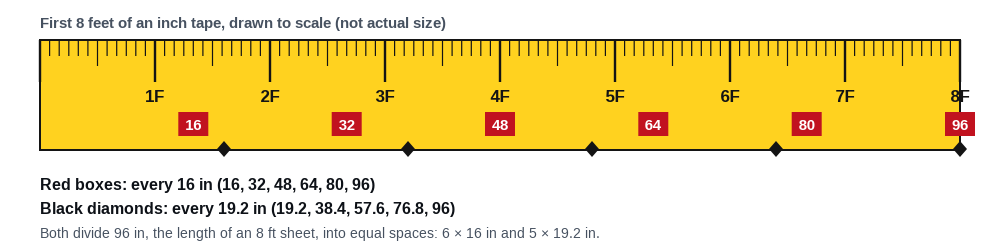
- Red numbers or boxes every 16 inches show stud spacing. The usual distance between wall studs is 16 inches, center to center, and many tapes mark it in red (Family Handyman).
- Small black diamonds every 19.2 inches are truss marks, used to space floor trusses across an 8-foot span (Family Handyman). 19.2 inches doesn't land on a sixteenth, so on the blade the diamond sits at 19 3/16 inches.
Both come from the 8-foot (96-inch) sheet of plywood or drywall: 96 divides into 6 spaces of 16 inches or 5 spaces of 19.2 inches, so the edges of each sheet land on a stud or a truss.
Why the hook moves
The metal hook at the end slides back and forth by its own thickness (Family Handyman). When you hook it over an edge and pull, it slides out; when you push it against a wall, it slides in. Either way the measurement starts at the true zero. A hook that has been bent no longer does this, and every reading will be off by the same amount.
Metric and two-scale tapes
On a metric tape the numbers are centimeters and each small line is a millimeter, with a slightly longer line at every 5 mm. Two-scale tapes put inches on one edge and centimeters on the other, which is handy for checking a conversion. For a converter that answers in tape-measure fractions, use the length converter.
Measure on screen
Questions people ask
What are the black diamonds on a tape measure?
They are truss marks, every 19.2 inches. Five of those spaces make 96 inches, the length of a standard 8-foot sheet, so builders use them to space floor trusses or joists evenly under each sheet.
Why are some numbers red on a tape measure?
On many tapes, red numbers or red boxes mark every 16 inches (16, 32, 48 and so on). That is the usual spacing of wall studs, measured center to center, so the red marks show where each stud goes.
Why does the end of my tape measure wiggle?
The hook is meant to slide by its own thickness. Pulled against an edge, it moves out; pushed against a wall, it moves in. Either way the measurement starts from the true zero, so the loose hook is working as designed.
How do I read 1/32 on a tape measure?
Some tapes split the first foot into 32nds. Count the tiny lines after the last 1/16 mark: one more line is an extra 1/32. A reading of 5/16 plus one tiny line is 11/32 inch.